ORTHODONTICS Article
Edges That Matter: Why Aligner Trimlines Influence More Than You Think
Dr. Shalin Shah
CDOCS Faculty

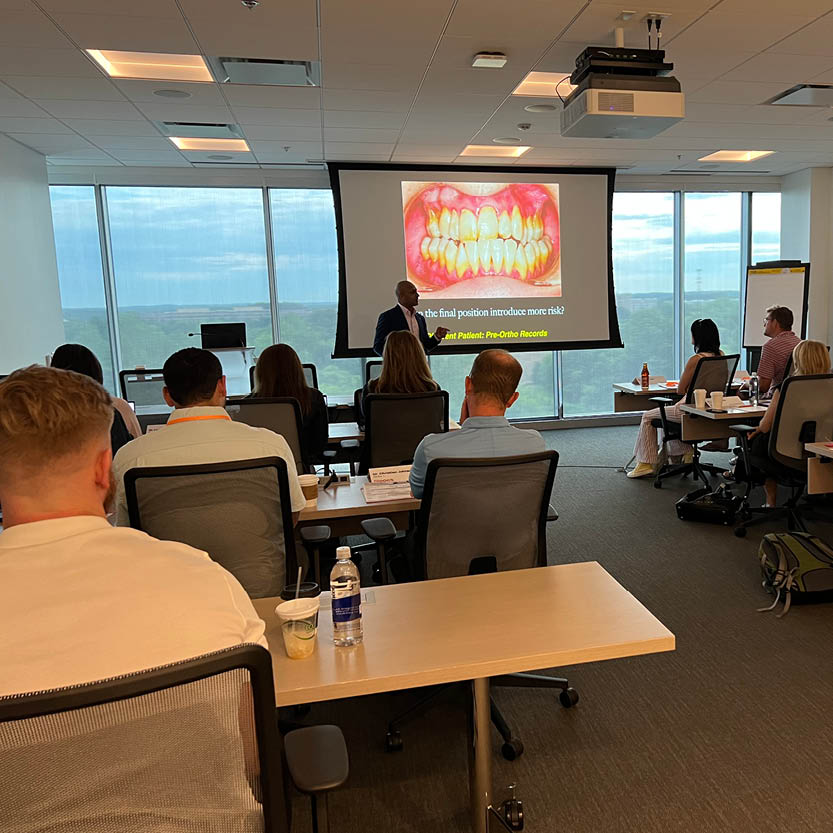
In clear aligner therapy, we often direct our attention to the visible drivers of movement—attachments, staging protocols, IPR, and case selection. Yet, some of the most influential variables sit quietly at the margins. Literally. Aligner trimlines, the way an aligner is cut along the gingival interface, are often treated as a minor design detail. In reality, they represent a meaningful biomechanical decision that can influence retention, force delivery, and ultimately, treatment predictability. This was the inspiration behind a recent discussion I shared on the CDOCS Discussion Board platform, where we explored the keys behind trimline design and why they deserve a more intentional place in our clinical thinking.
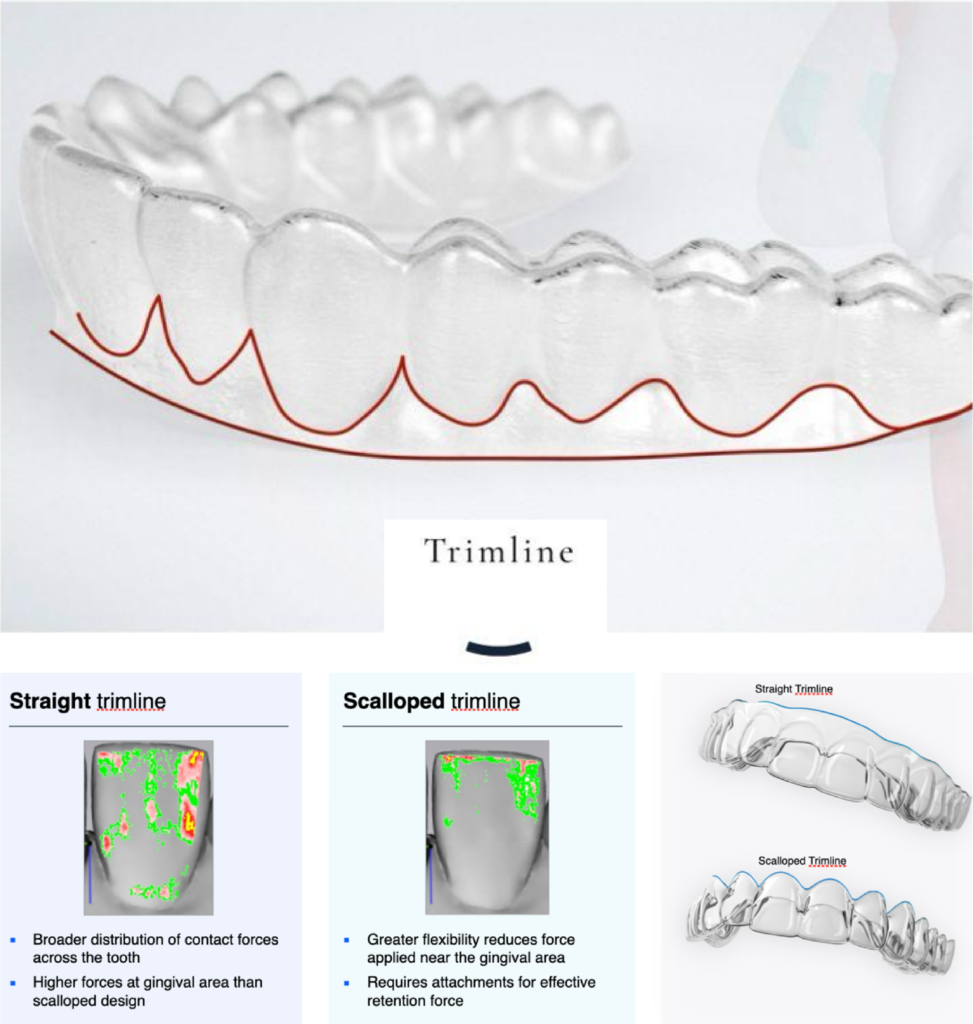
Very few aligner systems present two primary trimline approaches: scalloped trimlines, which follow the natural gingival contour, and straight trimlines, which extend beyond the gingival margin in a uniform plane. At a glance, the difference may appear subtle. Clinically, however, the implications are significant.
A 2022 in vitro investigation evaluating trimline geometry demonstrated that straight, extended trimlines produce more uniform and effective force distribution compared to scalloped designs. The scalloped configuration showed reduced cervical force transmission, while the straight extended design generated higher and more consistent force values across the tooth surface. Similarly, earlier work by Cowley, Mah, and O’Toole demonstrated that straight gingival margins increase aligner retention and reduce flexibility, improving the appliance’s ability to express more complex movements such as torque. Notably, the most retentive design evaluated in that study extended beyond the gingival zenith, reinforcing the importance of vertical coverage. A more recent systematic review (2024) further supports this concept, concluding that extended trimlines enhance both force delivery and retention, particularly for movements requiring precise control—translation, intrusion, tipping, and root torque. Taken together, the literature is pointing in a consistent direction: the more effectively an aligner engages the tooth, the more predictably it can move it.
In clinical practice, we often recommend a straight trimline extending approximately 1 mm past the gingival margin. While the literature broadly supports extended designs, the deeper reasoning lies in how the aligner interacts with the tooth at the interproximal level. When the trimline extends beyond the gingival margin, the aligner can invaginate more effectively into the embrasure space. This is a critical zone—one of the most influential areas for mechanical engagement and force expression.
A helpful way to conceptualize this is through an analogy from removable prosthodontics. In a removable partial denture, the retentive clasp achieves stability by extending into an undercut below the height of contour. It is intentionally positioned to engage a region that provides mechanical advantage. Aligners, while fundamentally different appliances, can leverage a similar principle. By extending just beyond the gingival margin, a straight trimline gains access to a more favorable zone of engagement—one that supports retention, control, and the expression of programmed biomechanics. In contrast, a scalloped trimline, which terminates at or near the gingival zenith, may limit that engagement. Less engagement. Less control. And in aligner therapy, control is everything.
What makes trimlines powerful is not just their effect—but their subtlety. This is not about adding more attachments or increasing case complexity. It is about refining the interface between appliance and anatomy. It is about recognizing that even a millimeter of material can shift the predictability of a case.
This is also why we emphasize trimline design in Clear Aligner Excellence for Dentists and Their Teams, Part 1—not as an isolated concept, but as part of a larger philosophy: understanding the why behind the workflow. When clinicians begin to see aligners not just as trays, but as engineered force systems, every design choice becomes more intentional, more precise, and more repeatable. And ultimately, more rewarding for both the patient and the team.


Conclusion:
Sometimes, the biggest advancements in clinical outcomes don’t come from doing more. They come from seeing more clearly. A slightly extended trimline. A deeper understanding of engagement. A more intentional approach to design. And suddenly, what once felt variable becomes predictable. That is where confidence lives. That is where growth happens. And that is where great orthodontics begin.
Related CDOCS Hands-On Workshops
Clear Aligner Excellence for Dentists and Their Teams, Part 1 (CO110)
Launch your aligner journey with a comprehensive introduction to orthodontic fundamentals, occlusion, case selection, and the SureSmile® Aligner system. This workshop equips restorative dentists to confidently plan, present, and manage clear aligner therapy.
Clear Aligner Excellence for Dentists and Their Teams, Part 2 (CO210)
Master advanced techniques such as attachment placement, interproximal reduction (IPR), and treatment timeline management using the SureSmile® system, while integrating digital workflows and refining patient communication strategies for optimal outcomes.