ORTHODONTICS Article
The Magic of Space: Rethinking IPR and Round-Tripping in Clear Aligner Therapy
Dr. Shalin Shah
CDOCS Faculty

There’s a quiet power in how we create space. In orthodontics, we know space is not just a requirement—it’s the runway for transformation. One of the most understated yet critical tools in that transformation is interproximal reduction (IPR). Often viewed as a simple procedure, IPR carries layers of nuance when approached with intention and strategy—especially when integrated with round-tripping protocols in clear aligner therapy.
Let’s peel back the curtain a bit.
Why IPR still matters
IPR is foundational. Whether treating mild crowding or aligning a complex adult case, the goal remains: facilitate proper tooth movement while maintaining a harmonious arch form and teeth centered in bone. We know that teeth won’t simply line up and centered in bone without room to do so—and this is where IPR quietly does its magic.
Performed between a pair of teeth, IPR gently removes enamel (often 0.1-0.5 mm) to allow for better tooth approximation. It’s routine in orthodontics, but in the digital age of aligners, the timing and strategy behind IPR make all the difference between good and exceptional outcomes.
Enter round-tripping: a strategic delay for a better result
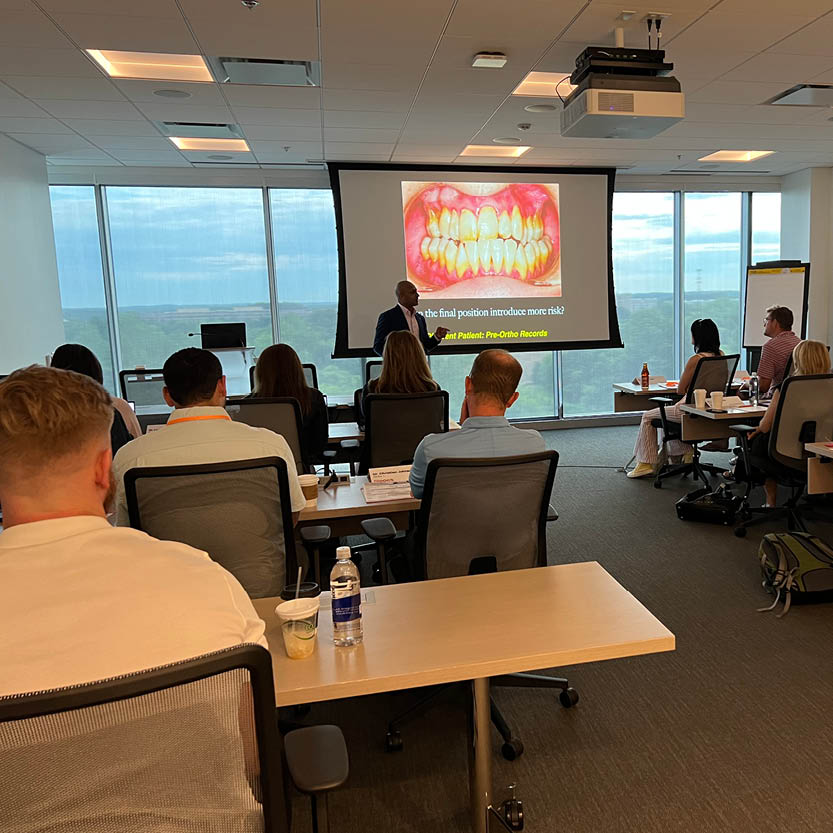
At our Clear Aligner Excellence workshops, we spend considerable time helping clinicians rethink when and how IPR should occur. One of the biggest clinical pearls? Stage your IPR later and allow teeth to “round-trip” into position when the teeth are too excessively overlapped for comfort.
What do we mean by round-tripping?
Rather than performing IPR at the onset of treatment, we can design aligner staging so the teeth are first moved slightly out of their crowded state—just enough to allow improved access for more precise IPR. By pushing buccally or adjusting torque in the early stages, the teeth begin to separate. Then, once better spacing is achieved, IPR is performed, and the teeth are gently guided back into optimal alignment.
This staged approach avoids the “blind filing” that often accompanies initial IPR on overlapping contacts. It’s safer, more controlled, and it supports enamel conservation by ensuring we don’t reduce more than necessary. Plus, it makes life easier for the restorative dentist performing clear aligner ortho when executing the reduction.
As one of our favorite Monday Morning Pearls: ask your technician to “stage my IPR later” or “request round-tripping” in cases of excessive misalignment.
The planning behind the magic
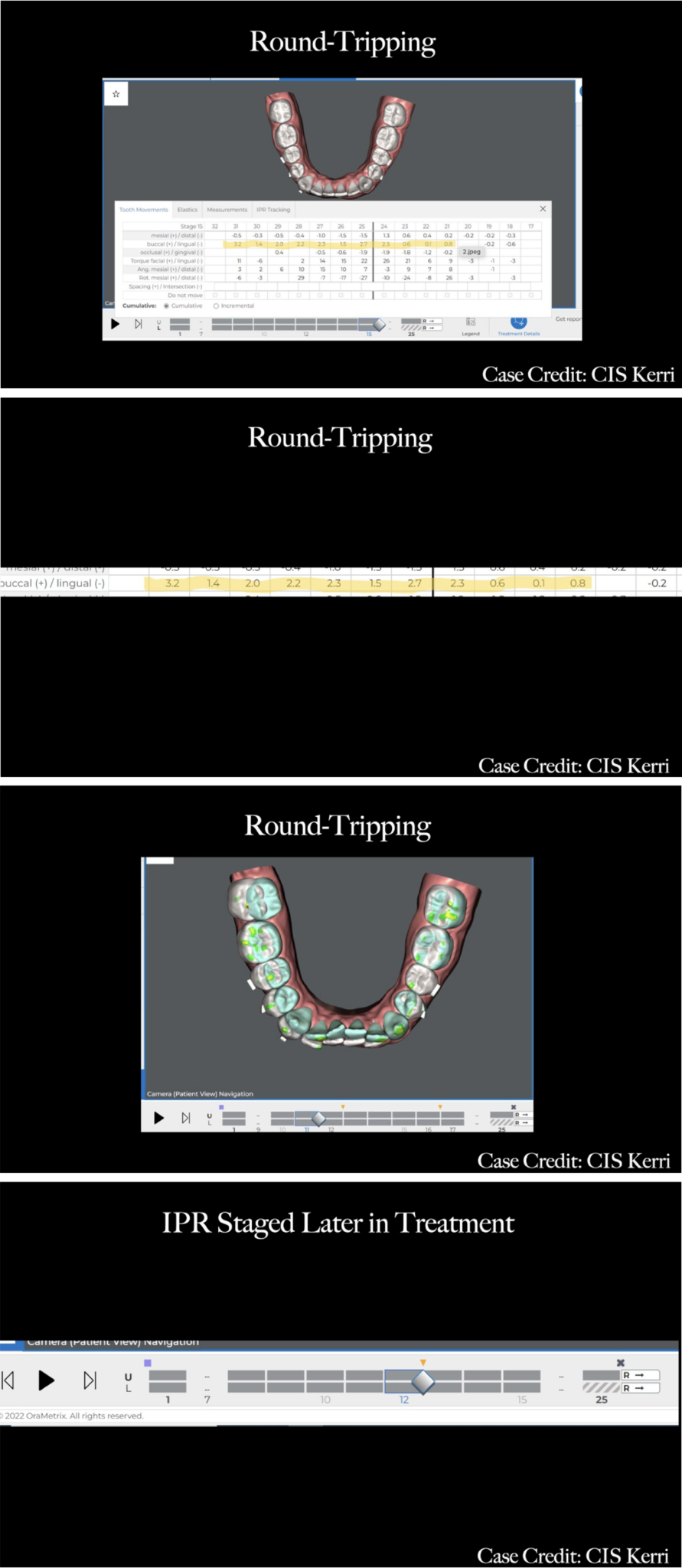
Modern digital setups allow us to visualize and customize this staging beautifully. The screenshots in this post illustrate how our team uses treatment planning platforms to track movement patterns over time, delaying IPR until proper spacing is naturally achieved.
In the case shared by our Dentsply Sirona colleague, Kerri (CIS Kerri), note how the buccal/lingual movement across multiple teeth allows for staggered round-tripping before any reduction occurs. The IPR is then digitally staged around tray 12, once sufficient access is available (see image titled “IPR Staged Later in Treatment”).
It’s an elegant dance: movement creates space, and space invites precision.
A human-Ccentered approach to digital orthodontics
We share this not just to teach technique, but to express a larger truth: excellence in aligner therapy is less about doing more—and more about doing what’s necessary, artfully timed. In our workshops, we don’t just walk through checklists—we celebrate the human connection between science, skill, and the smiles we help create.
We can’t wait to share more of this journey with you.
A human-Ccentered approach to digital orthodontics

IPR – Interproximal Reduction
- Space is necessary to move teeth into alignment
- Routine procedure in all of orthodontics
- Completed between a pair of teeth
- Monday start guide: request for “round-tripping” or “stage my IPR later” so the teeth can become better approximated in excessive misalignment
- Use hand files at the outset and space gauges to measure
Related CDOCS Hands-On Workshops
Clear Aligner Excellence for Dentists and Their Teams, Part 1 (CO110)
Launch your aligner journey with a comprehensive introduction to orthodontic fundamentals, occlusion, case selection, and the SureSmile® Aligner system. This workshop equips restorative dentists to confidently plan, present, and manage clear aligner therapy.
Clear Aligner Excellence for Dentists and Their Teams, Part 2 (CO210)
Master advanced techniques such as attachment placement, interproximal reduction (IPR), and treatment timeline management using the SureSmile® system, while integrating digital workflows and refining patient communication strategies for optimal outcomes.