
IMPLANT Article
“Doc, my implant is loose”… Screw loosening etiology and treatment.
Dr. Mark Ludlow
CDOCS Faculty

Dental implants have become a cornerstone of contemporary restorative dentistry, offering high long-term survival and predictable outcomes, yet there is nothing that causes more fear, trepidation, and the disruption of a schedule, than an implant complication.
While the list of surgical, biological, and prosthetic complications are nearly innumerable, mechanical prosthodontic complications involving the loosening of the implant/abutment interface are among the most experienced in clinical practice. Understanding the biomechanical etiology, risk factors, and evidence-based management strategies for these complications is essential for all clinicians involved in implant dentistry.
What Causes an Abutment to Loosen?
When a patient calls stating “my implant is loose…”, the most common cause is the loss of mechanical stability between the abutment and implant, often discernable as rotational or vertical mobility of the prosthetic component. The primary mechanism underlying this complication is a reduction in preload: the initial clamping force generated when the abutment screw is tightened (Winkler et al., 2003). Preload is critical for maintaining joint integrity; insufficient preload predisposes the implant/abutment connection to micromovement under functional loads, leading to screw loosening.
Several factors contribute to preload loss and subsequent abutment loosening:
- Connection design:
External hex designs historically exhibited higher loosening rates than internal connections, particularly when compared to conical (Morse taper) interfaces, which provide significantly greater joint stability (Goodacre et al., 2003; Jung et al., 2012).
- Torque application:
Inconsistent tightening technique, inadequate knowledge of the proper torque for the particular implant system being used, or a lack of calibrated torque control can result in inadequate preload (Lang et al., 2012).
- Prosthetic forces:
Off-axis loads, cantilevers, and non-axial occlusal forces increase bending moments on the abutment screw and promote micro-movement (Papaspyridakos et al., 2012).
- Restoration design:
Excessive crown height, improper contour, and prosthetic misfit can amplify functional loading at the implant–abutment interface.
The prevalence of abutment screw loosening has declined with advances in implant connection designs and torque control. Contemporary systematic reviews report loosening rates of approximately 5% for single-tooth implants (Jung et al., 2012; Jung et al., 2018), although rates may be higher in full-arch and cantilevered prostheses.
Management and Access of a Loose Implant Crown
When this happens to you, the treatment goal is to re-establish optimal preload and prosthesis stability while addressing any modifiable risk factors that may have contributed to the problem in the first place.
The first step is to access the abutment screw. This is a very simple process if the restoration is screw retained. Begin by removing the filling material along with any Teflon tape or cotton that is covering the abutment screw. Examine the screw head to assess any wear, stripping of the hex, or fracture of the abutment screw. If none of those are evident and the screw is in good working order, then retighten the abutment screw to the manufacturer specified torque using a calibrated torque driver (Linkevicius et al., 2015).
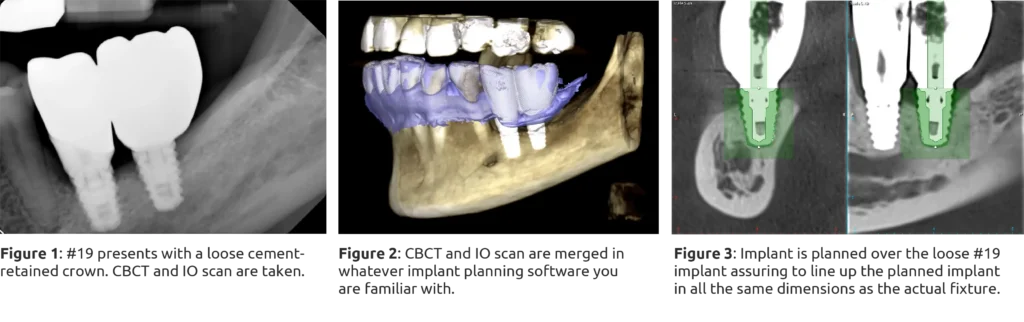
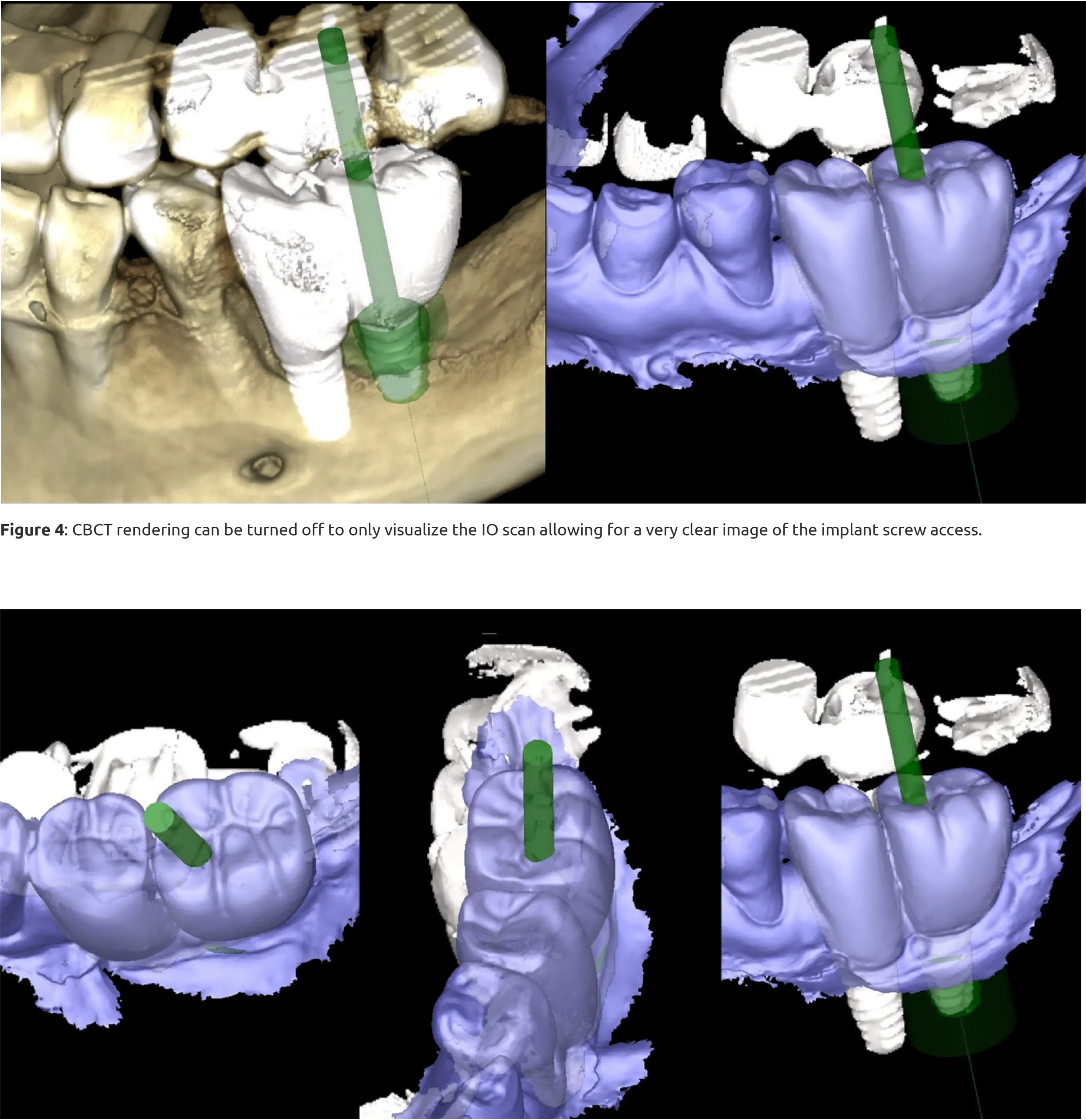
If the restoration is cement-retained (Figure 1), then the process is marginally more complicated as you must access the screw head. The procedure for doing this can vary depending on the technology of your office. If you have a CBCT, then take a CBCT of the area with the loose implant crown along with an intraoral scan of the same area. In the implant planning software included with your CBCT, merge the STL file of the intraoral scan along with the CBCT that was taken (Figure 2). Then plan an implant directly over the implant with the loose abutment/crown complex (Figure 3). This will allow you to then visualize exactly where the screw access will be and give you a very clear and simple path to access the loose cement-retained crown noting the access point on the occlusal portion of the crown along with the angles needed to successfully access the screw (Figures 4, 5). Use a diamond bur to drill through the porcelain then switch to a carbide if you’re dealing with a PFM crown. Once the access has been found, remove the Teflon tape/cotton and retorque as noted above.
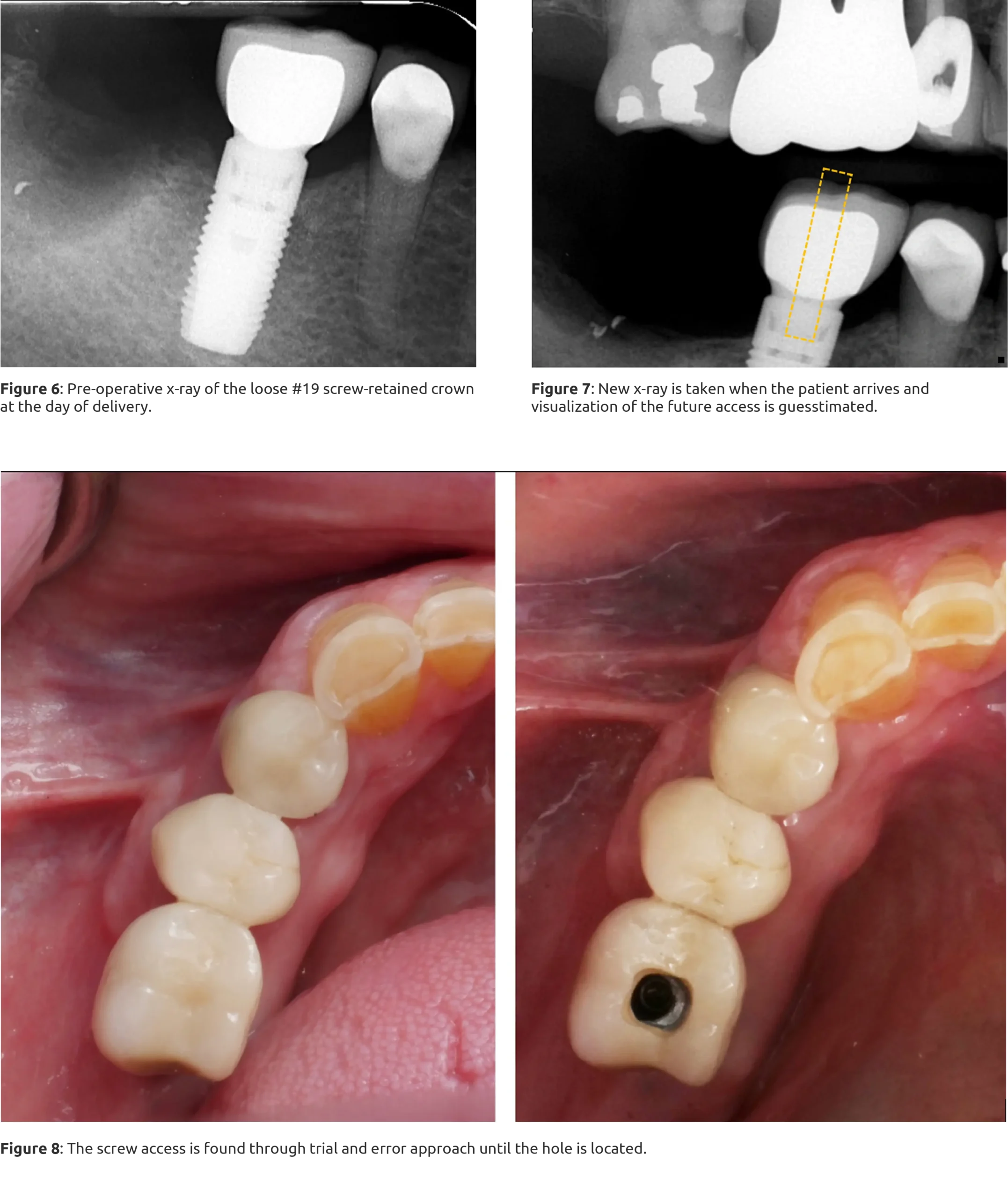
If you don’t have access to a CBCT, then the process is slightly harder as you don’t have a good way of determining the true 3-dimensional positioning of the implant. If this is the case, take a very good PA of the area assuring that the threads of the implant fixture are clear to assure good positioning (Figure 6). From this x-ray, visually estimate the trajectory of the screw in a 2-dimensional way and start on the occlusal table of the crown in your best guesstimate of where the access would be (Figure 7). If the access is not immediately found, move your access more buccal or lingual to try to get into the screw access channel. Once it is located, then follow the procedure from above.

Conclusion
In summary, abutment and screw loosening represent common yet largely manageable mechanical complications in implant dentistry that will happen to you at some unforeseen time in your career.
The loss of preload, whether from inadequate torque, unfavorable connection design, prosthetic misfit, or excessive functional loading, remains the central mechanism behind most “loose implant” presentations. Prompt diagnosis, methodical access to the abutment screw, careful inspection of components, and retightening with a calibrated torque device can often resolve the issue predictably.
By combining sound biomechanical principles with disciplined clinical protocols, you can transform what is often perceived as a stressful disruption into a controlled and routine aspect of implant maintenance, ultimately preserving both implant longevity and patient confidence.
Related CDOCS Hands-On Workshops
Complications in Implant Dentistry (CI180)
Prepare for the unexpected with hands-on training in diagnosing and resolving the most common surgical and prosthetic implant complications, including loose crowns, stripped screws, fractured abutments, and failed implants, to protect patients and your practice.
Achieving Predictable Results in Guided Implant Surgery (CI210)
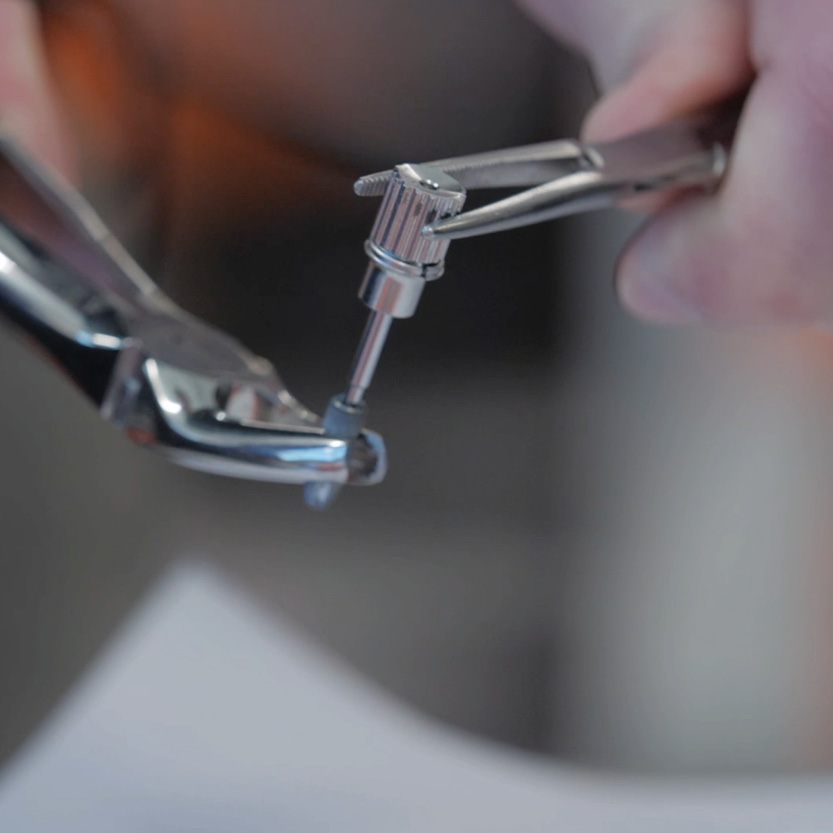
Elevate your implant skills with comprehensive training in Cone Beam CT surgical planning, intraoral scanning integration, and the full spectrum of guided surgery systems. This workshop gives clinicians at any experience level the tools to place implants with greater precision and confidence.